
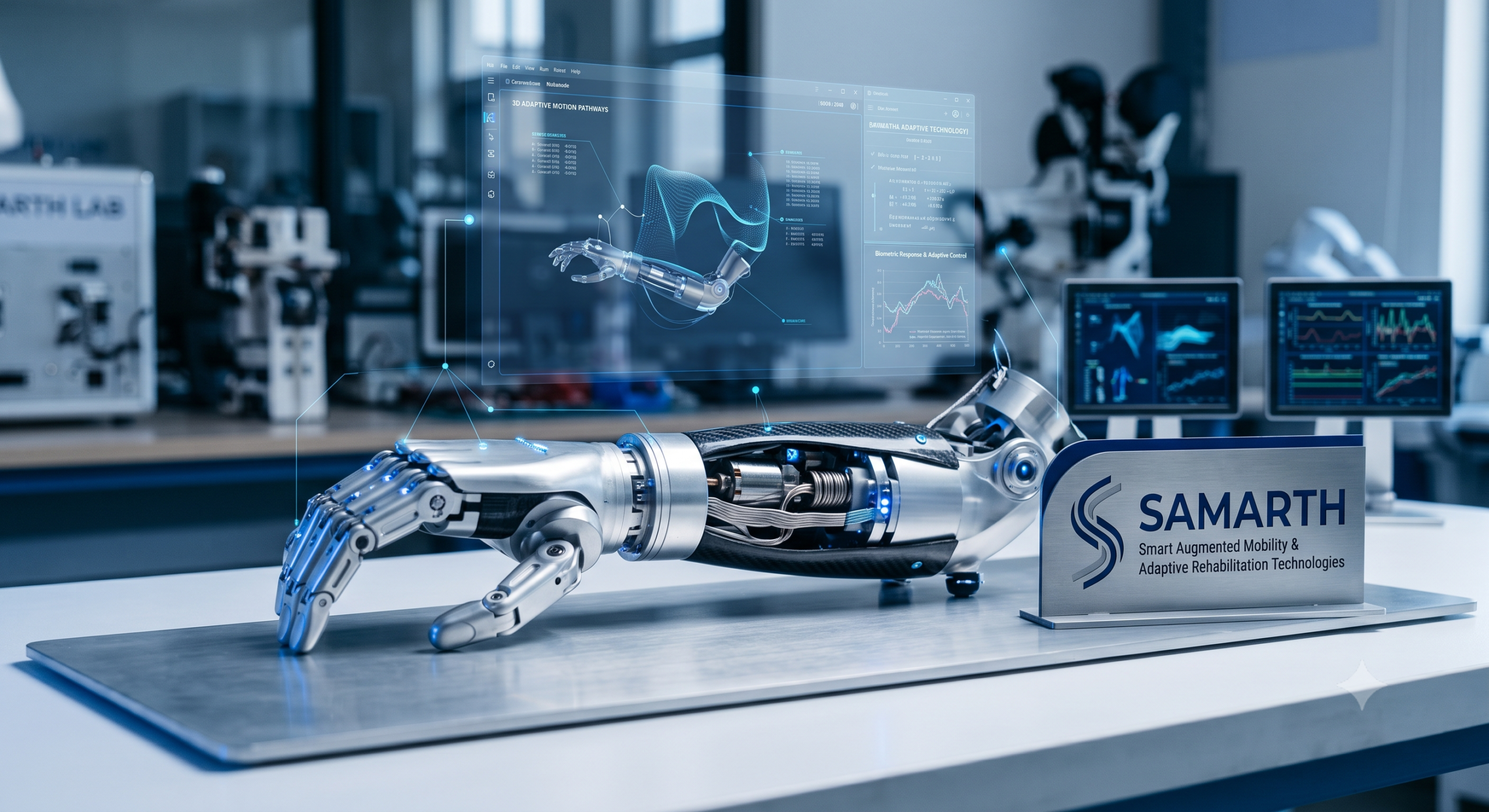
The Anatomy of Immobility: The Real-World Crisis Behind Rehabilitation Technology
We live in a world that moves fast. We take for granted the seamless coordination it takes to stand up from a chair, walk to the door, or step over a curb. But for millions of individuals globally, these effortless actions represent a lost frontier.
Whether caused by a sudden spinal cord injury, a stroke, or a progressive neuromuscular condition, immobility changes everything in a fraction of a second.
While medicine has gotten incredibly good at keeping people alive after catastrophic health events, the engineering world is still lagging behind when it comes to helping people live fully. The current assistive technology ecosystem is fundamentally broken. To understand why SAMARTH (Smart Augmented Mobility & Adaptive Rehabilitation Technologies for Humans) exists, we have to look past the clinical terminology and look at the actual human problem.
The Three Broken Realities of Current Mobility Aids
When a patient enters a traditional physical rehabilitation pipeline today, they run headfirst into three hidden structural problems:
1. The Trap of Permanent Dependency
Most current mobility aids—like traditional wheel chairs or standard rigid leg braces—are passive. They are built for compensation, not recovery.
When an assistive device does 100% of the mechanical work indefinitely, the patient’s remaining muscles quickly atrophy, and the brain stops trying to send signals to those limbs. This creates a feedback loop of permanent dependency. The tool meant to liberate the patient ends up locking them into their physical limitations.
2. The Clinical “Cliff”
True neuro-rehabilitation requires thousands of repetitions over months and years to trigger neuroplasticity (the brain’s ability to rewire itself). However, insurance caps and healthcare costs mean patients are often discharged from clinics the moment they achieve basic, assisted stability.
Once home, they hit a data “cliff.” The physical therapist has no eyes on how the patient moves, how their gait deteriorates throughout the day, or whether their posture is causing secondary joint damage. Without data, tracking recovery becomes impossible guesswork.
3. The Gap Between Lab and Life
If you look at modern research papers, the technology to solve this looks amazing. Elite university laboratories feature highly advanced, multi-million dollar robotic exoskeletons.
But these devices are completely impractical for the real world. They are heavy, bound by thick cords to lab computers, require a team of engineers to operate, and are astronomically expensive. Brilliant laboratory breakthroughs are trapped on the wrong side of the door, completely out of reach for ordinary families.
[ Traditional Approach ] ----> Static Compensation ----> Clinical Data Blackout
                                                               │
                                                       Permanent Dependency

[ SAMARTH Approach    ] ----> Adaptive Assistance ----> Continuous Cloud Insights
                                                               │
                                                       Restored Autonomy
Why “Smart” and “Adaptive” is the Only Way Forward
The human body is dynamic; it changes day by day, hour by hour. A patient waking up at 8:00 AM has different muscle fatigue levels than they do at 4:00 PM. A static piece of plastic or a rigid motor cannot account for this.
Tomorrow’s mobility systems must be fundamentally intelligent. They need to solve the problem through three core transformations:
Predictive Intent: Devices must use advanced sensing frameworks to read micro-muscular or neural changes, predicting the user’s movement intent milliseconds before they take a step.
Bio-Adaptive Assistance: If a patient has the strength to complete 30% of a stride, the machine should only supply the missing 70%. As the patient gets stronger, the machine must dynamically back off, forcing the human nervous system to do the hard work of rebuilding neural paths.
Democratized Scale: Advanced biomechanics must be engineered into lightweight, affordable frameworks that can transition from high-end research projects into a lean, venture-backed startup model capable of mass manufacturing.
Changing the Definition of Assistive Tech
The ultimate goal of rehabilitation engineering isn’t simply to build a cool piece of machinery; it is to restore human dignity, independence, and long-term vitality.
By building a bridge between elite laboratory research and everyday clinical reality, SAMARTH is targeting the root bottlenecks of immobility. We are working to ensure that a medical diagnosis no longer dictates the boundaries of what a human being can achieve.