
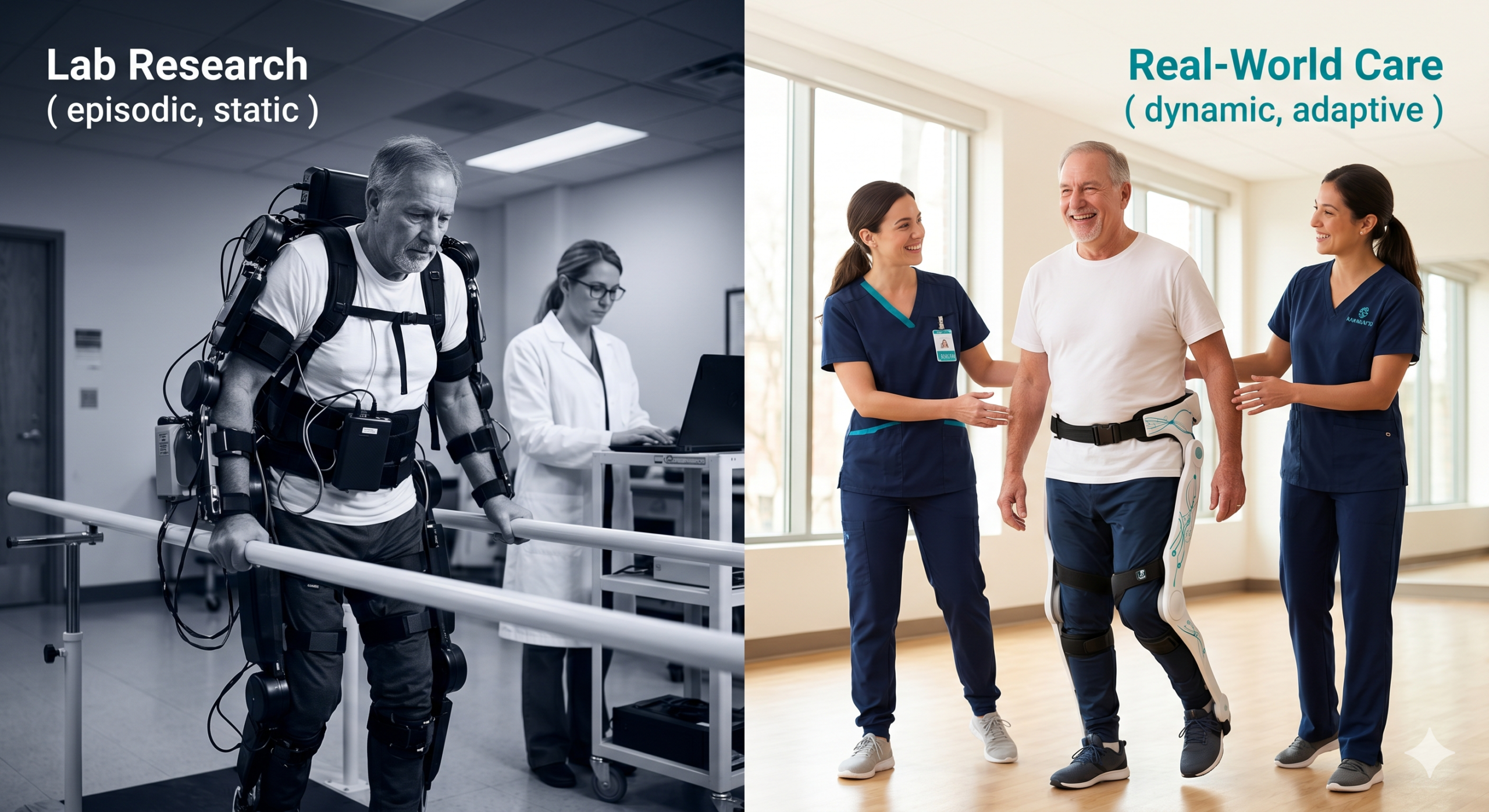
Imagine waking up one day and finding that your body no longer obeys your commands. For millions of people worldwide living with spinal cord injuries, strokes, neuromuscular disorders, or age-related mobility decline, this isn’t a hypothetical scenario—it is a daily reality.
Historically, the medical field has treated mobility impairment as a permanent state to be managed, rather than a dynamic challenge to be solved. Patients are often handed a traditional wheelchair or a standard walker and told to adapt to their limitations.
But standard engineering is no longer enough. The intersection of deep technology and clinical medicine is giving rise to a new philosophy—one championed by ventures like SAMARTH (Smart Augmented Mobility & Adaptive Rehabilitation Technologies for Humans).
To understand why this shift is critical, we have to look closely at the massive, systemic failures in current physical rehabilitation and mobility systems.
The Invisible Crisis in Human Mobility
When a person loses the ability to walk or move independently, the impact stretches far beyond physical limitations. It triggers a cascade of secondary health and psychological crises:
- The Physiological Toll: Prolonged immobility leads to muscle atrophy, severe bone density loss, poor blood circulation, and chronic pressure ulcers. The human body was designed to stand and move; sitting permanently actively degrades it.
- The Psychological Barrier: Relying completely on caregivers for basic human functions profoundly impacts mental health, often leading to severe depression, anxiety, and a loss of personal autonomy.
- The Economic Strain: Traditional rehabilitation requires hundreds of hours of high-cost, one-on-one sessions with physical therapists. For the vast majority of families globally, the financial burden quickly becomes unsustainable, forcing patients to abandon therapy prematurely.
Why Traditional Rehabilitation Solutions Fall Short
If you visit a standard rehabilitation clinic today, you will likely see tools that haven’t changed fundamentally in decades. The current ecosystem suffers from three massive bottlenecks:
1. Static Instead of Adaptive
Traditional braces and orthotics are completely static. They provide rigid structural support but do not respond to the user’s changing muscle activity or environment. If a patient regains $10\%$ of their strength, a traditional brace doesn’t adapt to let them use it; it continues to do all the work, slowing down actual neurological recovery.
2. The “Cliff” of Clinical Discharge
Rehabilitation shouldn’t stop when a patient leaves the hospital. However, once a patient is discharged, data collection drops to zero. Clinicians have no way to monitor how a patient moves at home, whether their gait is deteriorating, or if their assistive device is causing secondary joint alignment issues.
3. Lack of Biological and Technological Convergence
True recovery requires a system that mirrors the human body itself—combining structural biomechanics with computational intelligence. Yesterday’s mobility aids completely lack the data processing capabilities required to understand human intent in real time.
The SAMARTH Paradigm: Engineering Intent into Motion
The core problem isn’t that the human body cannot heal or adapt; it’s that our assistive tools are blind, deaf, and rigid. This is exactly where the necessity for Smart Augmented Mobility and Adaptive Rehabilitation comes into play.
Solving this crisis requires building technologies that seamlessly integrate three distinct pillars:
[Advanced Biomechanics] <---> [Real-Time Data / AI] <---> [Human Intent]
- Smart Augmentation: Assistive devices must actively read neurological or muscular signals, predicting what the user wants to do and providing just the right amount of robotic assistance to achieve it.
- Adaptive Learning: As a patient regains neural connectivity and physical strength through neuroplasticity, the technology must automatically scale back its assistance, challenging the human body to do more of the heavy lifting.
- Continuous Monitoring: By embedding sensors directly into mobility frameworks, recovery data can stream securely to clinicians. This transforms rehabilitation from an episodic hospital visit into an ongoing, data-driven journey at home.
Moving From the Lab to the Bedside
The mathematical and engineering foundations required to solve human immobility already exist in elite research labs. The missing link has always been execution—translating complex algorithmic and robotic research into rugged, affordable, and accessible devices that can scale like a startup and reach real patients.
True independence shouldn’t be a luxury reserved for those who can afford experimental, multi-million dollar clinical trials. By anchoring cutting-edge research in practical design, the next generation of health-tech ventures can ensure that every individual, regardless of their background, has the opportunity to regain their movement, re-claim their dignity, and walk boldly into the future.
1 thought on “Breaking the Barriers of Human Motion: Why the Future of Rehabilitation Must Be Smart and Adaptive”